
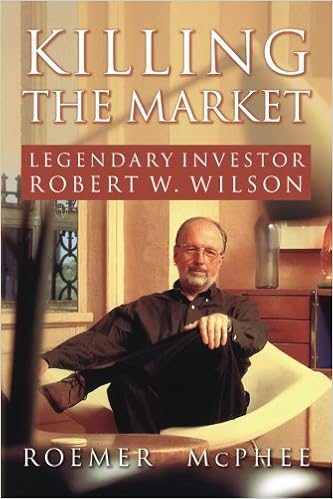
Executing the Market is a short, intriguing read about the life and profession of financial specialist and humanitarian Robert W. Wilson.
Given $15,000 from his mom in 1958 as a wedding present (equal to about $150,000 today) Wilson contributed the cash. That started a 40-year profession in the monetary market - playing the stocks - which landed him with a total assets of over $800 million preceding his demise in 2013.
Writer Roemer McPhee, a Princeton-prepared ever, poses the inquiry "How could he do it?" and tries (effectively, I think) to answer it in his book. He jumps into the life and work of Wilson in what is an itemized clarification of how Wilson could fulfill what nobody earlier or after him has done. How he could function the market to his support, and find, with a practically primal nature, what markets had a future.
Since I have a constrained information of the share trading system, a portion of the terms in this book were somewhat finished my head, yet what I discovered intriguing was the nitty gritty way McPhee depicts each enormous organization that Wilson put resources into. For me, it was fun perusing the subtle elements of how these organizations began - organizations I know about from my adolescence.
Wilson purchased stock in organizations, for example, Datapoint, Bowmar Instrument, Lockheed Aircraft Corporation, Atari, and Jordache Jeans before others comprehended what was happening. He additionally fiddled with oil when others were offering, and in the carriers business when it wasn't viewed as "productive."
"He generally appeared to be ready to detect a pioneer early," composes McPhee. "Wilson had right around an intuition for self-insurance and self-protection in the market, as a financial specialist."
One of the inquiries the books asks (and replies), is the thing that do you do with all that cash once you have it?
While there isn't much insight about his own life, we do discover that Wilson was a man extremely worried about the welfare of the earth and its occupants. He consistently "tithed" as he put it, providing for foundations and association all through his profession. When he resigned, in any case, he turned into a full-time humanitarian, and gave a huge number of dollars away, making him one of the greatest contributors in New York City and in the United States. His main concern was to keep dealing with the earth and the general population and creatures that lived on our planet. Like the subtle elements that McPhee puts in the book about the organizations Wilson purchased stock in, he likewise characterizes the associations he offered cash to, which I discovered intriguing on the grounds that I've known about the vast majority of these associations.
The book finishes Wilson to the finish of his life: Wilson remaining in character until the end.
When I visit New York, now, and I see his name on different structures or giver plaques, I'll know the story behind the name. I imagine that is cool.
I trust this book is ideal for anybody keen on contributing or playing the market, regardless of whether expert or beginner. For whatever is left of us, it makes an intriguing read into the life of a man who changed the lives of many individuals and many organizations in the US.
Given $15,000 from his mom in 1958 as a wedding present (equal to about $150,000 today) Wilson contributed the cash. That started a 40-year profession in the monetary market - playing the stocks - which landed him with a total assets of over $800 million preceding his demise in 2013.
Writer Roemer McPhee, a Princeton-prepared ever, poses the inquiry "How could he do it?" and tries (effectively, I think) to answer it in his book. He jumps into the life and work of Wilson in what is an itemized clarification of how Wilson could fulfill what nobody earlier or after him has done. How he could function the market to his support, and find, with a practically primal nature, what markets had a future.
Since I have a constrained information of the share trading system, a portion of the terms in this book were somewhat finished my head, yet what I discovered intriguing was the nitty gritty way McPhee depicts each enormous organization that Wilson put resources into. For me, it was fun perusing the subtle elements of how these organizations began - organizations I know about from my adolescence.
Wilson purchased stock in organizations, for example, Datapoint, Bowmar Instrument, Lockheed Aircraft Corporation, Atari, and Jordache Jeans before others comprehended what was happening. He additionally fiddled with oil when others were offering, and in the carriers business when it wasn't viewed as "productive."
"He generally appeared to be ready to detect a pioneer early," composes McPhee. "Wilson had right around an intuition for self-insurance and self-protection in the market, as a financial specialist."
One of the inquiries the books asks (and replies), is the thing that do you do with all that cash once you have it?
While there isn't much insight about his own life, we do discover that Wilson was a man extremely worried about the welfare of the earth and its occupants. He consistently "tithed" as he put it, providing for foundations and association all through his profession. When he resigned, in any case, he turned into a full-time humanitarian, and gave a huge number of dollars away, making him one of the greatest contributors in New York City and in the United States. His main concern was to keep dealing with the earth and the general population and creatures that lived on our planet. Like the subtle elements that McPhee puts in the book about the organizations Wilson purchased stock in, he likewise characterizes the associations he offered cash to, which I discovered intriguing on the grounds that I've known about the vast majority of these associations.
The book finishes Wilson to the finish of his life: Wilson remaining in character until the end.
When I visit New York, now, and I see his name on different structures or giver plaques, I'll know the story behind the name. I imagine that is cool.
I trust this book is ideal for anybody keen on contributing or playing the market, regardless of whether expert or beginner. For whatever is left of us, it makes an intriguing read into the life of a man who changed the lives of many individuals and many organizations in the US.


No comments:
Post a Comment